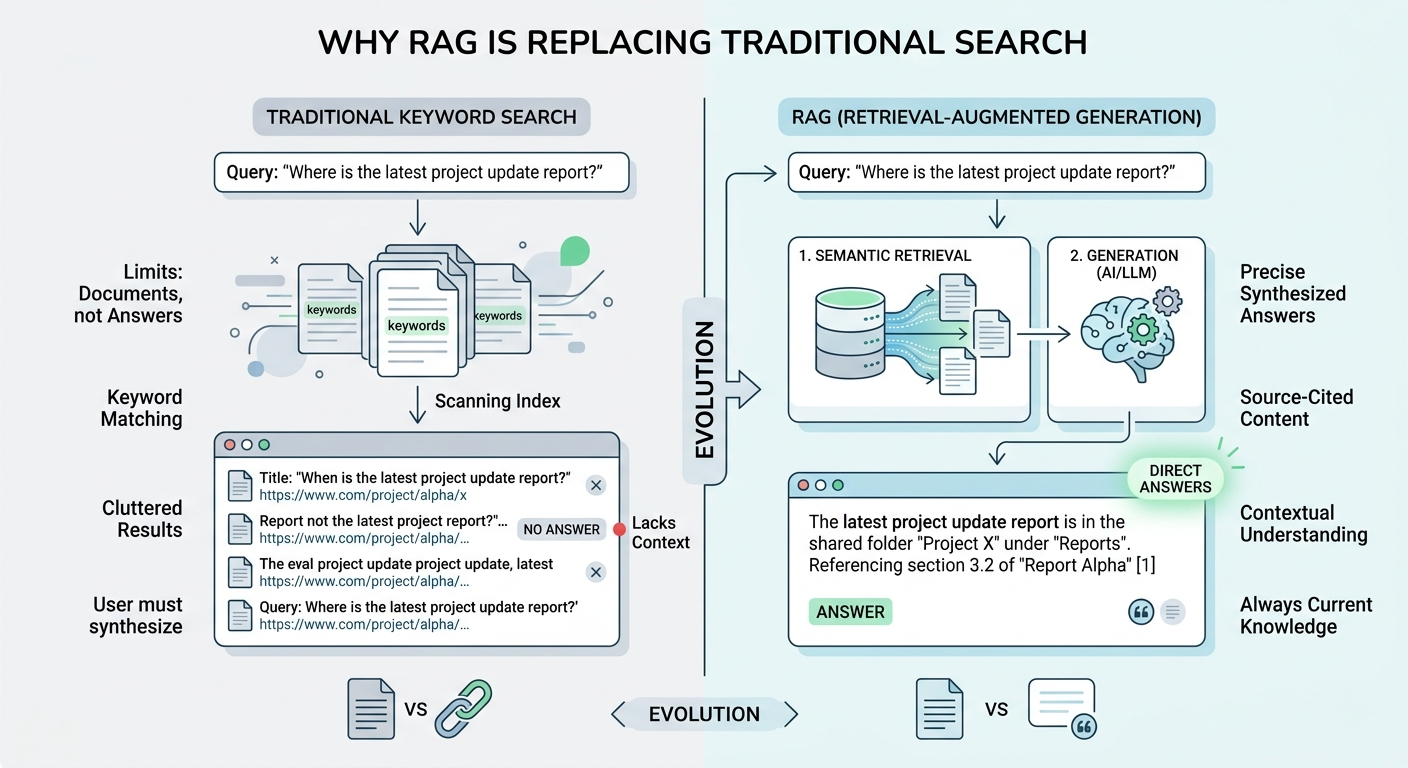
The limits of traditional search.
Keyword-based search has served enterprises well for decades, but it fundamentally breaks down when users need answers rather than links. Traditional search returns documents; RAG returns precise, source-cited answers synthesised from your entire knowledge base.
How RAG works.
Retrieval-Augmented Generation combines two powerful capabilities: semantic retrieval that finds relevant information across thousands of documents, and generative AI that synthesises those sources into coherent, contextual answers. The result is an AI assistant that knows everything your organisation knows.
RAG vs fine-tuning.
While fine-tuning bakes knowledge into model weights (expensive and quickly outdated), RAG retrieves knowledge at query time from your live document store. This means RAG stays current automatically, costs less to maintain, and provides source citations for every claim.
Implementation best practices.
Successful RAG implementations require careful attention to chunking strategy, embedding model selection, hybrid search combining dense and sparse retrieval, and thoughtful prompt engineering. The quality of retrieval directly determines the quality of generated answers.