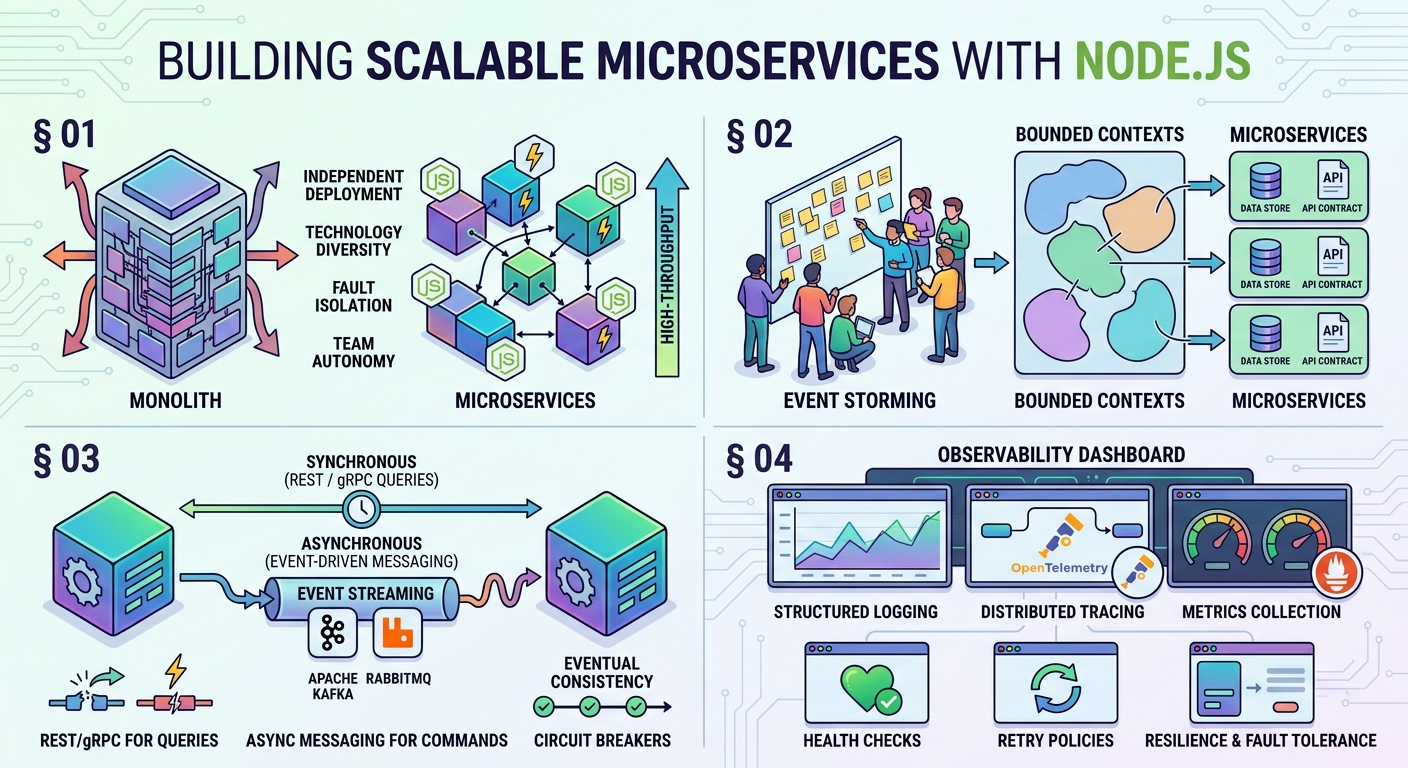
Why microservices at scale.
Monolithic architectures become a liability as applications grow. Microservices enable independent deployment, technology diversity, fault isolation, and team autonomy. Node.js, with its event-driven architecture and massive ecosystem, is ideally suited for high-throughput microservices.
Designing service boundaries.
The most critical decision in microservices architecture is defining service boundaries. Domain-Driven Design provides the best framework: identify bounded contexts through event storming, then map each context to a service with its own data store and API contract.
Inter-service communication.
Synchronous REST or gRPC for queries and asynchronous event-driven messaging for commands. Use Apache Kafka or RabbitMQ for event streaming, implement circuit breakers, and design for eventual consistency rather than distributed transactions.
Observability & resilience.
In distributed systems, observability is not optional. Implement structured logging, distributed tracing with OpenTelemetry, and metrics collection with Prometheus. Combine with health checks, retry policies, and graceful degradation for production-grade resilience.